2026 reads: winter into spring
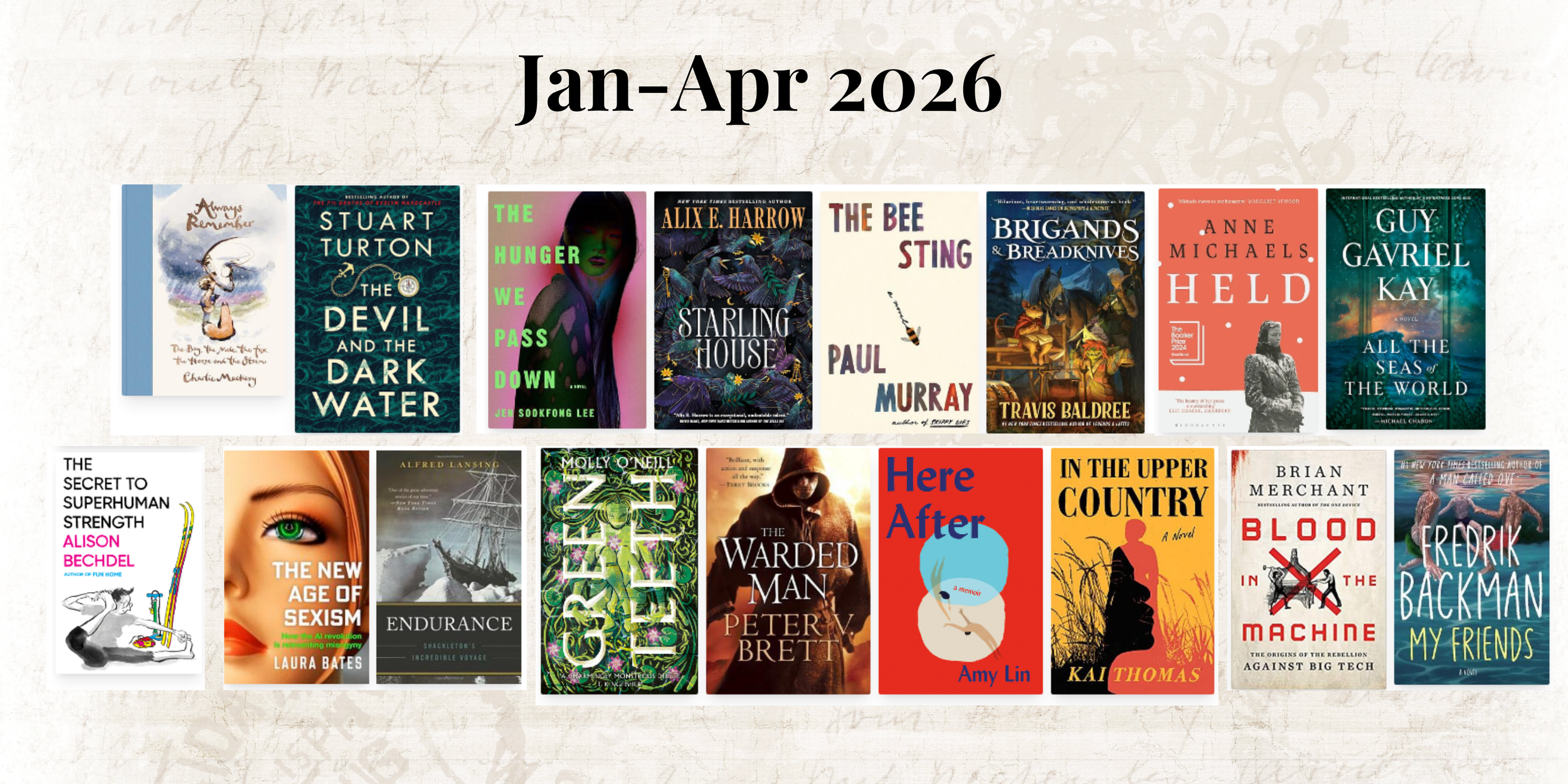
by Alana
2026 has been a slower reading year for me. I didn’t even set a Reading Challenge goal. I was curious to see if my relationship to reading would change if I removed the sense of urgency engendered by an arbitrary target of yearly books.
With changes to my career this year, I’m trying to be more intentional with my attention in all aspects of my life. In my reading, this means picking up more physical, print books, rereading passages when I catch myself starting to skim, hopping back in the audiobook to listen to compelling parts again. Everything else in the world asks us to go quickly; it’s been nice to slow things down.
I’ve split the review dump up by genres since this is a giant post. Have fun, and if you’ve read anything on the list, reach out so we can chat about it!
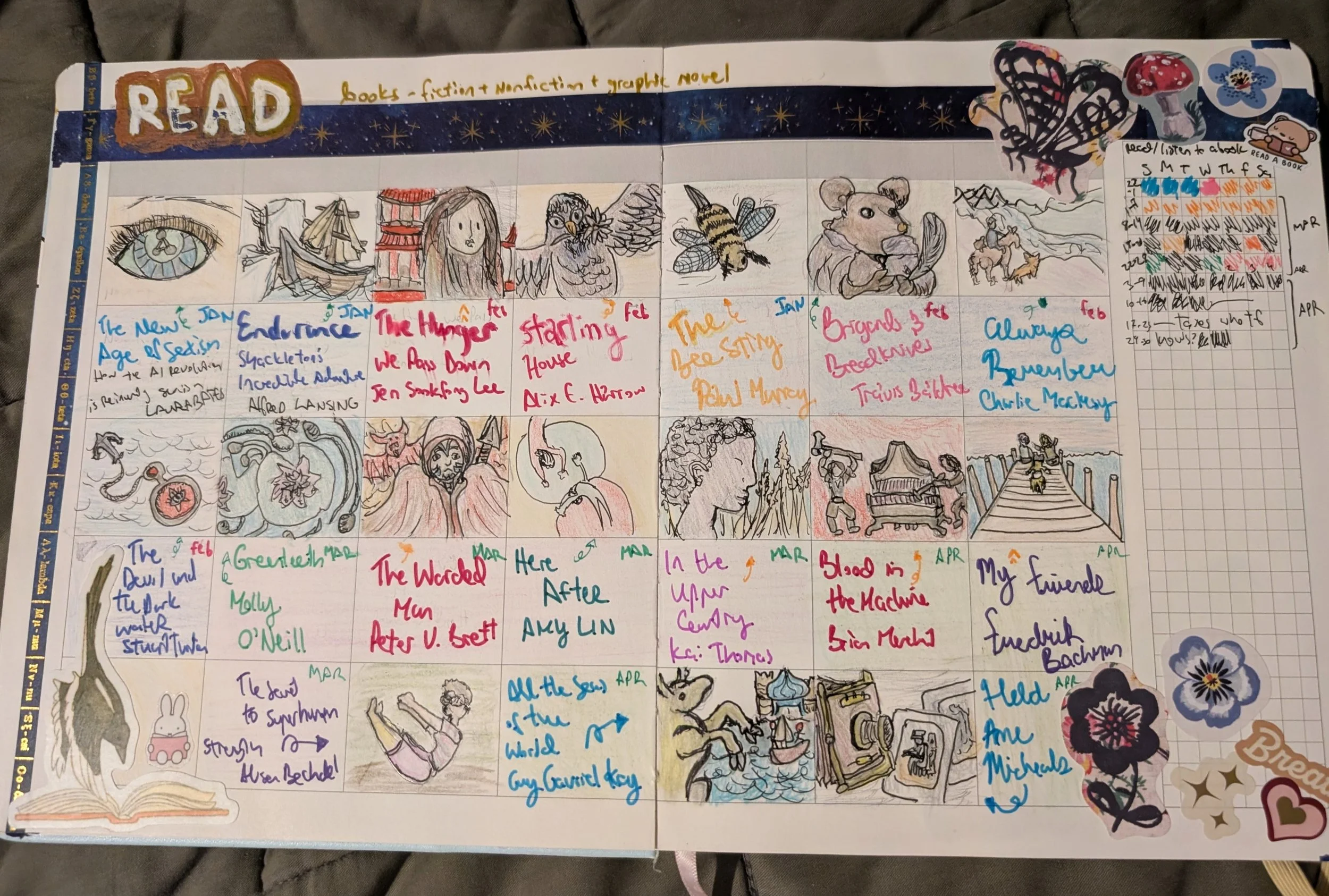
Last year I did a painting for every book I read. I liked how thinking about what I was going to paint changed my reading experience, but it was a ton of work. This year, I decided to scale it back to a small icon or image for each read instead.
Contemporary fiction
The Bee Sting - Paul Murray
Format and Genre: contemporary fiction
When and where: 2008, Ireland
A sprawling, incisive novel by Irish writer Paul Murray, The Bee Sting is told across time, perspective, and even voice (I’m always impressed by authors who justify using second person!). This 650+ page tome is set in rural Ireland, with sojourns to Trinity College in Dublin, and rotates through the points of views of four members of the Barnes family. With an increasing urgency signalled in both plot and structure, we watch tiny dramas unfold: a failing business and floundering marriage, a teenage girl’s navigation of identity, a young boy’s desperation to save his family.
This masterful sense of interiority - I cared so much about each character’s struggles - spirals while climate change, the 2008 recession, and an amorphous doom represented by prepper culture loom in the background. This book is work to unpack and the ending completely blew my mind. A read that will stick with me a long time, both for its canny rendering of human nature and for its ambitious marriage of story, theme, and form.
Recommended by Rosemary
My Friends - Fredrik Bachman
Format and genre: novel, contemporary fiction
When and where: from a busy city to a seaside Swedish town
A quirky, wholesome story told with all of Bachman’s usual adroitness. His penchant for simple sentences delivering heart wrenching truths was on full display in this story of unlikely friendship spurred by the death of a prominent artist. The push and pull relationship between a young, cynical orphan and a scared, lonely teacher dominates this story about lost friends. I realized I have more in common with the curmudgeonly forty-something who just wants some peace and quiet than the quirky young girl in this story, and wow, now I feel old. Not my favourite Bachman, but a soul-warming read all the same.
Nonfiction
New Age of Sexism: How the AI Revolution is Reinventing Misogyny - Laura Bates
Format and Genre: nonfiction essays
When and where: published 2025, western focus
The latest book of gender, tech, and society from feminist writer Laura Bates. More than once, I had to put this well-researched, deep-dive into AI’s impact on gender inequality down because the case studies were so horrifying. From conditioning boys to expect complete subservience from anyone female-identifying, to effortlessly enabling acts of digital violence against women of all ages, Bates’ research is persuasive about the damage AI is already doing to social ties and the necessity of stronger legal regulation, tech-literacy education, and safety features. This book is a must-read for anyone who dismisses AI-naysaying as reactive fear-mongering. The AI “revolution” is absolutely making the world worse for women you know, today.
Recommended by: Sagnik
Endurance: Shackleton’s Incredible Adventure - Alfred Lansing
Format and Genre: nonfiction historical
When and where: 1914-1917, Antarctica (published 1959)
A gripping account of the last major expedition of the Heroic Age of Antarctic Exploration. Fuelled and funded by British imperial hubris, Ernest Shackleton and his crew of men and dogs set out aboard the HMS Endurance to attempt the world’s first land crossing of the Antarctic continent.
The expedition failed at this goal, but the harrowing story of Shackleton and his crew’s survival is the most unfathomable account of human resilience I’ve ever read. Journalist Alfred Lansing chronicles day-to-day bravery and mistakes of the mission, consulting extensively from journals, photos, and illustrations kept by members of the 28-man expedition. Readers are pulled into the crew through Lansing's evocative descriptions - a riveting survival story for fans of mountaineering or wilderness tales.
Recommended by Coop
Here After - Amy Lin
Format and Genre: nonfiction memoir
When and where: Calgary area, contemporary
Amy Lin was thirty-one years old when her husband unexpectedly died. Here After draws a poetic map of the wild assault of feeling that follows sudden loss. Grief, identity, and memory are unpacked in her powerful, direct prose. Anyone who’s suffered loss of a loved one will see themselves in the messy honesty, blurred timelines, and emotional range of Lin’s writing. A brief but incredibly powerful read laid out in short, compelling chapters.
Blood in the Machine: The Origins of the Rebellion Against Big Tech - Brian Merchant
Format and Genre: nonfiction, historical
When and where: from 18th century Nottinghamshire and other cottage industry English counties to the corporate headquarters Silicon Valley’s tech giants of today
A well-researched, people-first historical account of the largest domestic organized resistance in British history. Today, “Luddite” is used as a shorthand for those recalcitrant to change, foolishly averse to “getting with the times” and adopting time-saving new technologies. Merchant’s thorough account of English history at the turn of the 18th century shows how wrong this pejorative use is.
The Luddite revolution was a response to sky-high food prices, mass worker displacement, the use of child labour, a lack of a minimum wage or maximum shift length, and a lack of respect for workers. Sound familiar? England under the industrial revolution has much to teach us today; the tech entrepreneurs of the Prince Regent’s time fought regulation, lobbied government, and abused workers, writing the playbook for the tech bros of today. Merchant follows the various chapters of Luddite resistance - from loom-smashing to political maneuvering to collective organizing - with hope that we will also learn from the bravery, solidarity, and determination of the Luddites. Highly recommended.
Fantasy
Greenteeth - Molly O’Neill
Format and Genre: cozy fantasy
When and where: in the lakes, forests, and hills of 17th century United Kingdom
The best cozy fantasy I’ve read in a while. O’Neill’s debut novel stars a swamp hag (who insists she is not a hag), a stubborn human witch, and a merchant goblin. The quirky trio combats ancient evil while asking themselves if a village of ungrateful humans and a realm where fae and mortals coexist is even worth saving.
O’Neill’s love for the land of her roots (she was born in the Cotswolds and later moved to Australia) was clear in her travelogue-esque descriptions. The sense of wonder in her prose got me itching to return to the Scottish highlands or English moors. Folklore and Arthurian legend interweave with the tough questions about identity and loyalty. A satisfying conclusion that honours the dark roots of traditional folklore. Perfect for any reader craving whimsy.
Recommended by Milana
(Shannon, I hope this rec makes up for Starling House)
Brigands and Breadknives - Travis Baldree
Format and Genre: cozy fantasy
When and where: the wonderful fantasy world of Baldree’s previous novels
After all the depressing nonfiction I read last year, I am on a cozy kick and don’t intend to stop. Baldree’s third book in his D&D-esque, delightfully tropey fantasy world follows Fern, a tiny mouse bookseller who doesn’t want to sell books anymore. When Fern drunkenly winds up travelling with a fabled elven hero who doesn’t want to do the hero bit anymore and a talking breadknife that claims it’s a greatsword, much questing, shenanigans, and friendship ensues.
Reading Baldree’s other earlier novels in this world (Legends and Lattes and Bookshops and Bonedust) isn’t necessary to enjoy this story, but you might as well read them because they’re dark-chocolate-delicious little fantasy romps.
The Warded Man - Peter V. Brett
Format and Genre: fantasy
When and where: the demon-haunted world of Annur
Nightmares wake in this first installment of the epic fantasy Demon Cycle series. Three narrators from similar humble beginnings traverse a world that is ravaged by demons every time the sun goes down. Each night, the people of both major trading cities and rural hamlets hide behind walls covered with magic wards that keep the demons at bay. A strong sense of character voice carries readers through as Brett cycles through unique narrators. I enjoyed the compelling world-building and sense of danger evoked by the premise, but like many Western fantasy novels of its time, Brett’s world is a tough one to be a woman in, and this book comes with heavy trigger warnings for sexual assault.
Lent to me by Matt
All the Seas of the World - Guy Gavriel Kay
Format and Genre: historical fantasy
When and where: the same pseudo-Europe setting of Kay’s Sarantine Mosaic
A slow but detailed story about two corsairs and their trading ship who get woven into a world of kingly assassinations, political machinations, and warfare. Kay is the king of the standalone fantasy novel, and his Sarantine Mosaic series invites readers to begin at any point. Though I enjoyed the other novels in this Europe-esque setting more, this meandering epic tackled themes that feel especially relevant today: what does it mean to leave the land of your birth behind? What right does one person have over another to impose their religion, their rule, or their militant will?
Kay’s use of omniscient, third-person narration gives a sense of historicity to all his Sarantine books, and this story was told with the same sense of subtle tragedy, richly human characters, and grand scale.
Historical fiction
The Devil and the Dark Water - Stuart Turton
Format and Genre: historical fiction mystery
When and where: 1634 on the ocean between the Dutch East Indies colony of Batavia (present day Jakarta, Indonesia) and Amsterdam, Netherlands
I will read anything genre-bending English author Stuart Turton writes… which is a shame because he averages about one massive, mindblowing book every three years. This devilish book chases its unlikely protagonists - a hulking Watson-character and a colonial governor’s brilliant wife - up and down the rigging, into bilgey holds, and among tempestuous waves as they discover who (or what) is haunting their cursed voyage across the Atlantic.
Rank with the stench of sailors and scurvy, the violence of the type of men who sailed India-ships for the Dutch, and the potential of Satan himself stalking the crew, this complex tale of intrigue kept me guessing until the end. A cunning mystery-meets-horror study in the corrupting influence of power, gold, and superstition. Not for everyone, but if you’re a patient mystery-reader who enjoys a strong historical setting and moral greyness, this book is for you.
In the Upper Country - Kai Thomas
Format and Genre: historical fiction novel
When and where: 1859, southern Ontario
Lesinda Martin, a young journalist, sits down to interview an old woman convicted of murdering a slave catcher. Instead of receiving an explanation, the journalist finds herself trading story for story. Set in Dunmore, a fictional Canadian town inspired by real places settled by people fleeing slavery. Rich with lush characterization of both people and place, Thomas’ debut novel delves back in time as the women share tales of Black enslavement and resistance, Indigenous partnership, and family upheaval. The dreamlike structure made the narrative hard to follow at times, but I very much enjoyed this fresh look at Canadian history.
Held - Anne Michaels
Format and Genre: historical fiction novella
When and where: 20th century Ontario
A highly poetic and heartbreaking account of generations of a family and their loose network of friends and lovers. Told across the World Wars and exploring the loss those conflicts left and the ways those familial ruptures rippled across time. Solipsistic and at times deeply confusing, but I enjoyed this novella’s sense of murky timelessness. A short little book by an award-winning Canadian icon.
Horror
The Hunger We Pass Down - Jen Sookfong Lee
Format and Genre: horror fiction
When and where: contemporary BC; WW2-era Hong Kong
From Japanese-occupied Hong Kong during the war to the gentrifying suburbs of Vancouver, Lee’s novel is both a literary exploration of Chinese culture and a visceral horrorshow where generation-haunting trauma takes physical form. Readers see forwards and backwards in time through the eyes of the Chow family. Gigi, abducted into Nam Koo Terrace, an infamous “comfort house” for Japanese soldiers; Alice, a single mum and entrepreneur stretched thin in that way many mothers know; Luna, teenaged, mixed-race, and grasping for belonging.
Narrators have a strong sense of voice and place, but the novel’s bleak plot is unrelenting. A creeping sense of dread morphs into full-throttle body-horror in the shocking conclusion. Not a pick-me-up read, but an interesting use of horror to unpack motherhood and the diaspora experience.
Recommended on CBC - reach out of if you’ve read it; I want to talk about that wild ending!
Starling House - Alix E. Harrow
Format and Genre: contemporary gothic fiction
When and where: the fictional small town of Eden, Kentucky, USA
Southern gothic haunted house story meets moody introvert romance where real estate agents and the coal industry are the bad guys - what more could you ask for?
Harrow’s latest urban fantasy novel is steeped in the superstitions of small town southern America with all the implied racism, classism, and othering you’d expect. A slowburn story about that spooky house at the edge of town, devils that rise with the mist, and awkward loners finding reasons to live. A fun, if meandering, read that was extra angsty in audiobook format.
(Shannon, I’m sorry I made you read this)
Graphic novel
Always Remember - Charlie Mackesy
Format and Genre: graphic novel
When and where: a delicate wild world
British artist and writer Charlie Mackesy returns to the lush, ethereal forests of his first bestselling graphic novel to follow the adventures of four friends: a boy, a horse, a mole, and a fox. Together, they ponder some of life’s big questions, rendered in Mackesy’s dreamy inkbrush and watercolour style. I adore both Mackesy’s delicate style and the simplicity of his writing. A comfort read you could finish in an afternoon but will return to on busy and bad days.
A gift from Anton
The Secret to Superhuman Strength - Alison Bechdel
Format and genre: graphic novel, memoir
When and where: all the corners of America Bechdel lived
An illustrated memoir that explores the author’s lifelong obsession with physical fitness and exercise in all its trappings. I browsed the first few pages in an Ottawa bookstore and as a sometimes cynical fitness instructor I needed to get it. Bechdel (of Bechdel test fame) wields her trademark wit and self-deprecating humour as she guides readers through the philosophies (from the Romantics, to eastern luminaries, to Beat poets) that shaped her outlook and all the wild trends we accept in the fitness industry. When I look at all the reformer Pilates studios popping up, I can’t help but wonder what clever quip Bechdel would say about toned abs, ankle loops, and sliding carriages. That way, I suspect, does not lie the secret to superhuman strength.